
Lithium-ion batteries power every electric scooter on the road today. Whether you are commuting daily or riding on weekends, battery life directly determines your experience. But here is what most riders do not know: with the same battery, different usage habits can mean a 3x to 5x difference in lifespan. Based on research data from Battery University, this guide shows you exactly how to extend your battery life through science-backed charging practices.
Why Do Lithium Batteries Age?
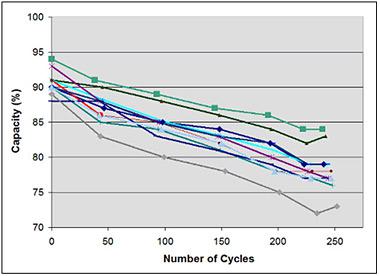
Lithium-ion batteries work by shuttling ions between positive and negative electrodes. In theory, this mechanism could run forever — but in practice, charge/discharge cycling, elevated temperature, and high-voltage storage all accelerate aging. Most consumer Li-ion batteries are rated for 300–500 cycles, but with smart charging strategies, that number can increase dramatically.
The chart above shows 11 brand-new lithium-polymer cells tested in a lab. After 250 full discharge cycles (1C charge to 4.20V, 1C discharge to 3.0V), capacity dropped from 88–94% down to 73–84%. This is the same reason your scooter does not go as far after a year of use — it is not broken, it is just aging.
The Four Factors That Determine Battery Life
1. Depth of Discharge (DoD): Charge Often, Live Longer
This is the single most important factor. The shallower the discharge, the more cycles your battery can deliver:
| Depth of Discharge | NMC Cycles | LiFePO₄ Cycles |
|---|---|---|
| 100% DoD | ~300 | ~600 |
| 60% DoD | ~600 | ~1,500 |
| 20% DoD | ~2,000 | ~9,000 |
| 10% DoD | ~6,000 | ~15,000 |
Takeaway: Do not wait until the battery is dead to charge. Plug in when you hit 30–40% and keep your depth of discharge within 60–70%. This alone can extend battery life by 2–3x. Lithium-ion has no memory effect — topping up throughout the day is perfectly fine.
2. Charge Voltage: A Little Less Goes a Long Way
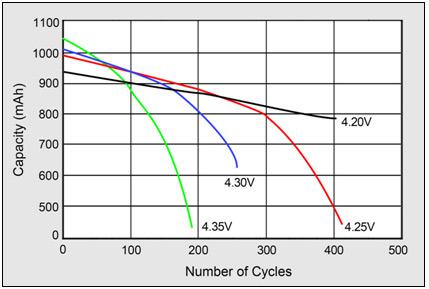
Most riders habitually charge to 100%, but this is one of the biggest contributors to accelerated aging — especially in warm conditions. Every 0.1V reduction in peak charge voltage roughly doubles the cycle life.
| Charge Voltage | Discharge Cycles | Available Capacity |
|---|---|---|
| 4.20V (Full) | 300–500 | 100% |
| 4.06V | 600–1,000 | 81% |
| 3.92V (Optimal) | 1,200–2,000 | 65% |
Takeaway: Charge to 80–90% for daily use. Only charge to 100% when you need maximum range. Many high-end electric scooters and EVs already offer a “Daily mode” (80%) and “Trip mode” (100%) option for exactly this reason.
3. Operating Window: Stay in the Sweet Spot
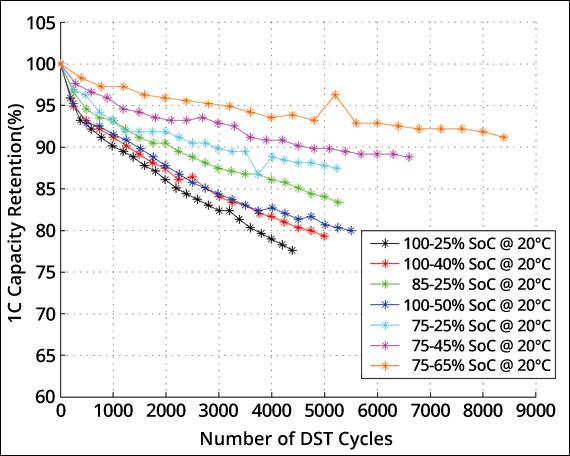
The chart above shows how different operating windows affect battery longevity. Running the battery in a 75%–25% window (using only 50% of total capacity) yields 3,000 cycles at 90% capacity retention, delivering 150,000 energy units over its lifetime. In contrast, a full 100%–25% window produces the shortest life.
Takeaway: Keep your battery between 25% and 85% for daily riding. This is the golden rule in the EV industry — it satisfies daily range needs while maximizing battery lifespan.
4. Temperature: The Silent Battery Killer
What damages lithium batteries most? Not cycling — it is high temperature combined with full charge storage. The data is sobering:
| Storage Temperature | 40% Charge — 1 Year | 100% Charge — 1 Year |
|---|---|---|
| 0°C (32°F) | 98% | 94% |
| 25°C (77°F) | 96% | 80% |
| 40°C (104°F) | 85% | 65% |
| 60°C (140°F) | 75% (3 months) | 60% (3 months) |
At 40°C with a full charge, a battery loses 35% of its capacity in just one year. The same battery stored at 0°C with only 40% charge retains 98%.
Takeaway:
- Never leave your scooter in a hot car or under direct sunlight
- For long-term storage, keep the battery at 40–50% in a cool place
- Avoid charging immediately after a ride — let the battery cool down first
- Do not charge in direct sunlight or near heat sources
Summary: The 6 Golden Rules of Battery Care
- Avoid deep discharges — plug in at 30–40%, do not wait for auto-shutdown
- Charge to 80–90% daily — save 100% for long trips only
- Stay in the 25%–85% zone — this is the battery sweet spot
- Keep it cool — avoid heat exposure during storage and charging
- Store at half charge — 40–50% is the ideal long-term storage level
- Top up anytime — Li-ion has no memory effect; partial charges are healthy
Data source: Battery University — BU-808: How to Prolong Lithium-based Batteries
Want to learn more about scooter maintenance?